
Dyes: characteristics and properties
The world of beauty and cleaning is full of products with vibrant colors. Within a formulation, colorants enhance the sensory characteristics of the product, significantly contributing to attracting the customer through sight. But have you ever stopped to think about what's behind this component?
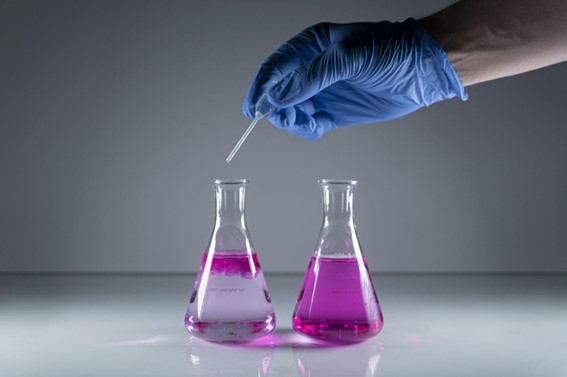
A better understanding of dyes, their characteristics, and their properties helps in the creation and development process of a product, aiming to combine all the components of the formula to achieve harmony.
Continue reading to discover the use of dyes in cleaning and cosmetic formulations.
How do dyes work?
A dye is a substance capable of imparting or altering the color of a medium. This occurs because dyes are made up of molecules that absorb radiation between 400 and 700 nanometers in wavelength, also known as the visible light range.
White light strikes the surface of a material so that part of it is absorbed and the other part, which is reflected, characterizes the various existing colors and shades. A green dye, for example, has the ability to absorb the wavelengths of all other colors except the specific wavelength of green, so this will be the reflected color.
The diagram below illustrates how this process occurs:
.png)
Types of dyes
Dyes can be natural or synthetic, so their function within a system remains the same, regardless of how they are obtained.
The structure of a dye molecule, in addition to dictating the color of the material, also reveals another important characteristic: its solubility.
They can be water-soluble, meaning they can dissolve in water or aqueous media, or fat-soluble, which dissolve in oils, silicones, and nonpolar systems in general.
Within these two categories, we can identify several types suitable for use in cleaning products and cosmetics, each with its own advantages and disadvantages, as can be seen in the table below:
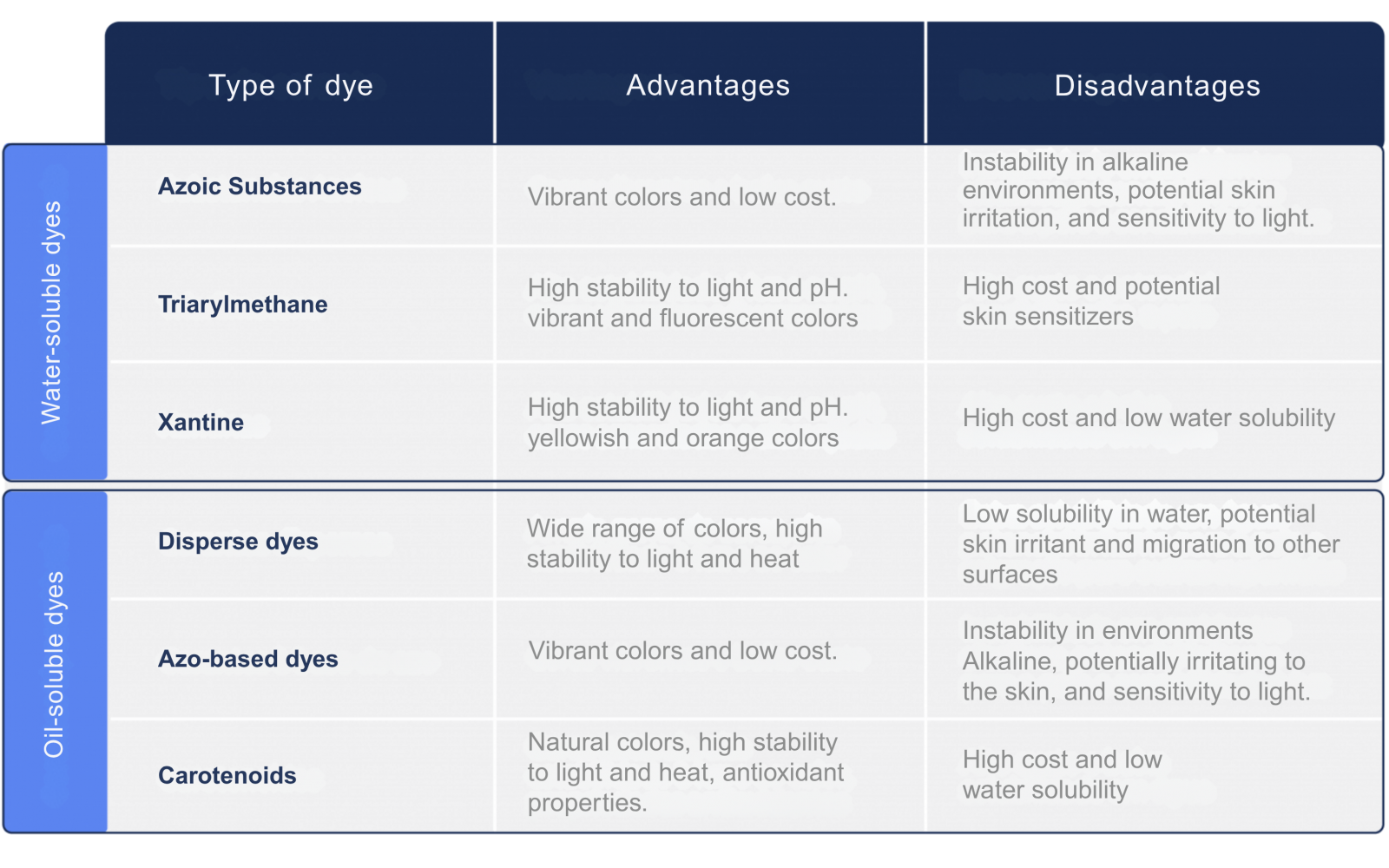
Furthermore, another category is that of polymeric dyes, which stand out as a technological innovation that redefines the possibilities of coloring in cleaning and cosmetic products.
Unlike traditional dyes, polymer dyes are composed of water-insoluble polymer molecules that encapsulate pigments within them. This innovative structure gives polymer dyes unique characteristics that make them the ideal choice for various applications.
Among its main benefits are:
- High dispersibility: Uniform dispersion in the formulation, preventing lumps and sedimentation.
- Intense shine and vibrant colors: They reflect light exceptionally well, resulting in vibrant and bright colors that enhance the product's aesthetics.
- Excellent stability: They resist degradation from light, heat, and pH, guaranteeing the product's original color for an extended period, even in unfavorable environments.
- Sensory effect: They provide a smooth and velvety feel on the skin, as well as preventing unpleasant odors and unwanted stains.
Another class of components that are often confused with dyes are pigments. This is because the difference between them is basically solubility. Pigments are solid, insoluble particles that also have the ability to add or alter the color of a medium. However, these particles do not dissolve and make the medium opaque. Furthermore, over time, pigments tend to settle, so it is necessary to use a suspending agent to keep the particles suspended.
Function of dyes
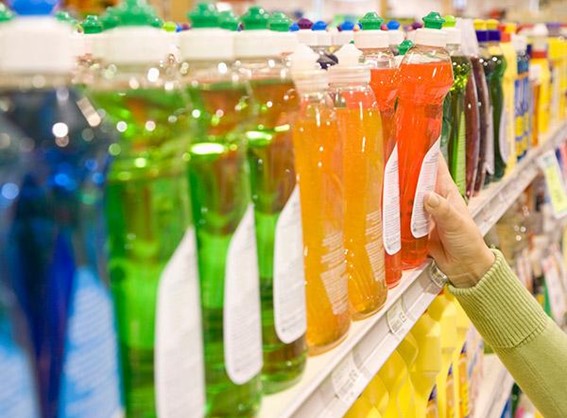
Since sight is one of the most important senses and is usually the first sense to be stimulated in the consumer experience, colorants can play more than one role, having a significant part within this universe.
- Increase visual appeal: Vibrant and eye-catching colors attract the consumer's attention and boost sales.
- Differentiate products: To differentiate the functions or fragrances of each formulation, making it easier for the consumer to choose.
- Color-based orientation: Standardized colors can indicate different types of products or their specific functions, making identification and use easier for the consumer.
Influences on formulations
The interference of dyes in formulations can affect various physicochemical characteristics and compromise the product's effectiveness and stability. Here are some impacts:
- Change in viscosity: Some dyes can increase or decrease the viscosity of the product, affecting its texture and application.
- Color change: Interaction with other components of the formulation may lead to color change or the formation of precipitates.
- Increased turbidity: Inadequate dispersion of the dye can result in a cloudy and opaque product, compromising its appearance.
- Incompatibility with other ingredients: Interaction with surfactants, preservatives, or other active ingredients present in the formulation may lead to precipitation, loss of color, or even the formation of undesirable compounds.
- Chemical instability: Some dyes can degrade when in contact with other components of the formulation, altering their properties and potentially generating harmful byproducts. In this case, it is essential to pay attention to water quality, especially the iron content, as iron tends to react with the dye, causing the product to change color over time.
A balance between visual appeal and functionality.
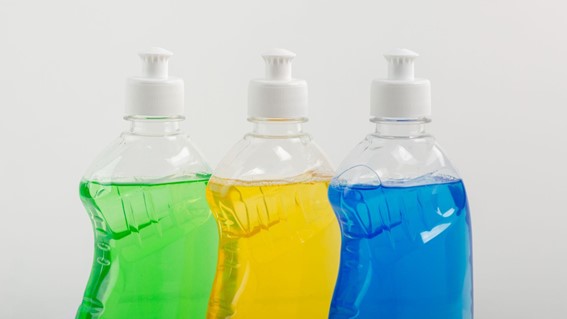
Choosing the ideal colorants ensures that beauty and functionality come together in perfect harmony, providing positive experiences for consumers and boosting sales.
Need help creating and developing a product? Count on our SmartLab.
Learn More
Understand what HLB is used for and how it helps you choose the ideal surfactant to create more stable emulsions.
The quality of the formulation depends on the raw materials, and minor variations can lead to losses. With this in mind, Macler developed TrustScan, a proprietary evaluation methodology. Through it, we ensure reliable and safe final products.
Isogen QUALI, a Macler solution developed as a technological alternative to simplify detergent formulations, acting as a single base capable of replacing multiple surfactants simultaneously.
Our chemistry
We use our labs to create
intelligent chemical solutions balanced with your reality.
Products
We use our R&D center, our own laboratory with experienced professionals, to deliver intelligent chemical solutions in balance with your reality.
