
Kerolain Faoro Teixeira Analista de P&D

The problem: Why don't oil and water mix?
Imagine an oil-in-water emulsion, such as an oily fragrance dispersed in an aqueous disinfectant. Oil and water, as we know, do not mix naturally. They are like two characters from completely different stories: without a mediator, they simply cannot coexist.
That's where the protagonist of our story comes in: the surfactant.
.jpg)
Think of it as a teacher in a classroom full of students who are all very different from one another. On one side, we have water, which loves everything that’s polar. On the other, we have oil, which prefers its own nonpolar world. The teacher’s role—the surfactant—is to help these two “students” get along in harmony.
But not all teachers use the same methodology. Some communicate better with water; others, with oil. It is precisely this characteristic that the HLB system seeks to describe.
What is HLB?
The Hydrophilic-Lipophilic Balance (HLB) is a numerical system that expresses the balance between two components of a surfactant:
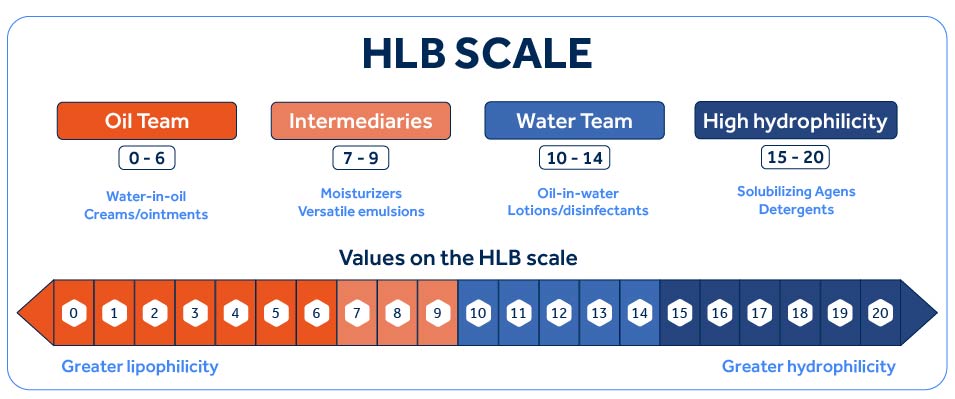
The scale ranges from 0 to 20. The higher the HLB value, the more the surfactant “speaks the language of water.” The lower the value, the closer it is to the “language of oil.” In summary:
This balance directly guides the selection of the right surfactant for each formulation.
The HLB Scale in Practice
The chart below summarizes the HLB ranges and their most common applications:
Why use surfactant blends?
In practice, a single surfactant rarely possesses exactly the characteristics needed to stabilize an emulsion. For this reason, it is common to combine two or more surfactants. This strategy offers advantages beyond simply adjusting the HLB:
When different surfactants are used simultaneously, their molecules can organize themselves into structures called mixed micelles: combinations that take advantage of the characteristics of each component, resulting in performance superior to that of any of the surfactants used alone.
Want to learn more about surfactants and micellar behavior? Click here to read the full article on our blog.
How to Calculate the HLB of a Mixture
Os valores de HLB dos tensoativos são calculados a partir da estrutura molecular da molécula. Existem dois métodos principais:
Griffin's method (1949): for nonionic surfactants
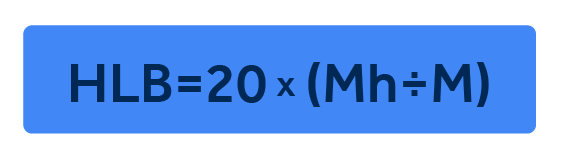
Developed by William C. Griffin, this is the most common method for fatty acid esters and ethylene oxide derivatives (such as Tweens and Spans). The formula is based on the mass fraction of the hydrophilic portion:
Davies Method (1957): for ionic and nonionic surfactants
The Davies method assigns fixed numerical values to each chemical segment of the molecule. It has the advantage of also working for ionic surfactants, such as sodium lauryl sulfate.

Examples of group values:
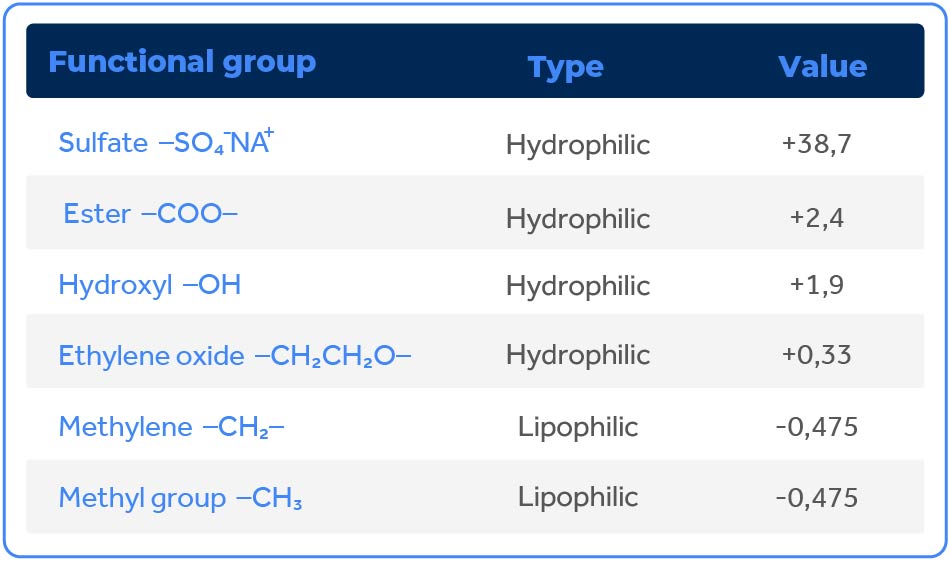
Sodium Lauryl Sulfate (SLS), for example, has a sulfate group (–SO-Na+, value +38.7) and a long carbon chain of 12 carbon atoms (12 × –CH–, total value –5.7). Using the Davies method, its HLB would be approximately 7 + 38.7 - 5.7 = 40—which indicates an extremely hydrophilic molecule, consistent with its use as a detergent and foaming agent.
In simple terms, the HLB can be calculated easily using the weighted average of the concentrations:

Here is a practical example:
In other words, by combining equal parts of each surfactant, we obtain a mixture with an HLB of 11, which is suitable, for example, for oil-in-water emulsions with oils of moderate affinity.
Sorbitan Esters: A Classic Example
Among the surfactants most commonly used in research and in the development of emulsions are sorbitan esters, known by the brand names Span® and Tween®. They clearly illustrate the logic behind mixtures:
Combining the two allows you to adjust the average HLB to any desired value simply by varying the proportion of each component.
Note:
Sorbitan esters are widely used in academic studies, but that does not mean they are the best or most suitable choice for all cases. For each emulsion system, it is necessary to evaluate which type of surfactant is most appropriate.
What is Required HLB (HLBr)?
So far, we have discussed HLB as a property of the surfactant. However, there is also the concept of Required HLB, or HLBr, which is a property of the oil phase of the emulsion.
The HLBr is the HLB value that the emulsifying system must have in order to stabilize a given oil in a given formulation. In other words, each oil “requires” a specific type of surfactant.
Some examples for reference:
When the HLB of the emulsifying system approaches the HLBr of the oil phase, the result tends to be more stable and homogeneous emulsions.
How is HLBr determined in practice?
HLBr is not a fixed, absolute value. It is determined experimentally because it is influenced by various factors in addition to the oil itself: the composition of the aqueous phase, temperature, the ionic strength of the system, and the presence of other ingredients.
In practice, the methodology works as follows:
Once the HLBr has been determined, the next step is to determine the minimum surfactant concentration required to stabilize the emulsion for the product’s shelf life, again through a series of tests at different concentrations.
HLBr tables available in the literature
There are reference tables listing the HLB values of various oils. These are useful for reducing the number of initial tests, but should be used only as a starting point; the specific conditions of each formulation can alter the system’s actual HLB value.
HLB is a fundamental concept for anyone working with emulsions in the chemical industry. Understanding the scale, the logic behind surfactant blends, and the concept of HLBr allows for the development of more stable, more efficient formulations with fewer trials and errors.
Despite its limitations—especially the fact that the HLB value is influenced by multiple factors within the system—the HLB remains an excellent starting point for selecting emulsifiers, accelerating product development.
Do you have any questions about the HLB value of your formulation? Contact Macler’s SmartLab. Our technical team can help you identify and develop the emulsifier system best suited to your needs.
The quality of the formulation depends on the raw materials, and minor variations can lead to losses. With this in mind, Macler developed TrustScan, a proprietary evaluation methodology. Through it, we ensure reliable and safe final products.
Isogen QUALI, a Macler solution developed as a technological alternative to simplify detergent formulations, acting as a single base capable of replacing multiple surfactants simultaneously.
Macler has developed Isogen EVOX, a solution that facilitates the development of formulations with hydrogen peroxide.
We use our labs to create
intelligent chemical solutions balanced with your reality.
We use our R&D center, our own laboratory with experienced professionals, to deliver intelligent chemical solutions in balance with your reality.
We use cookies on our site to give you the best experience possible. By continuing to browse the site, you agree to this use. For more information on how we use cookies, see our Privacy Policy.
